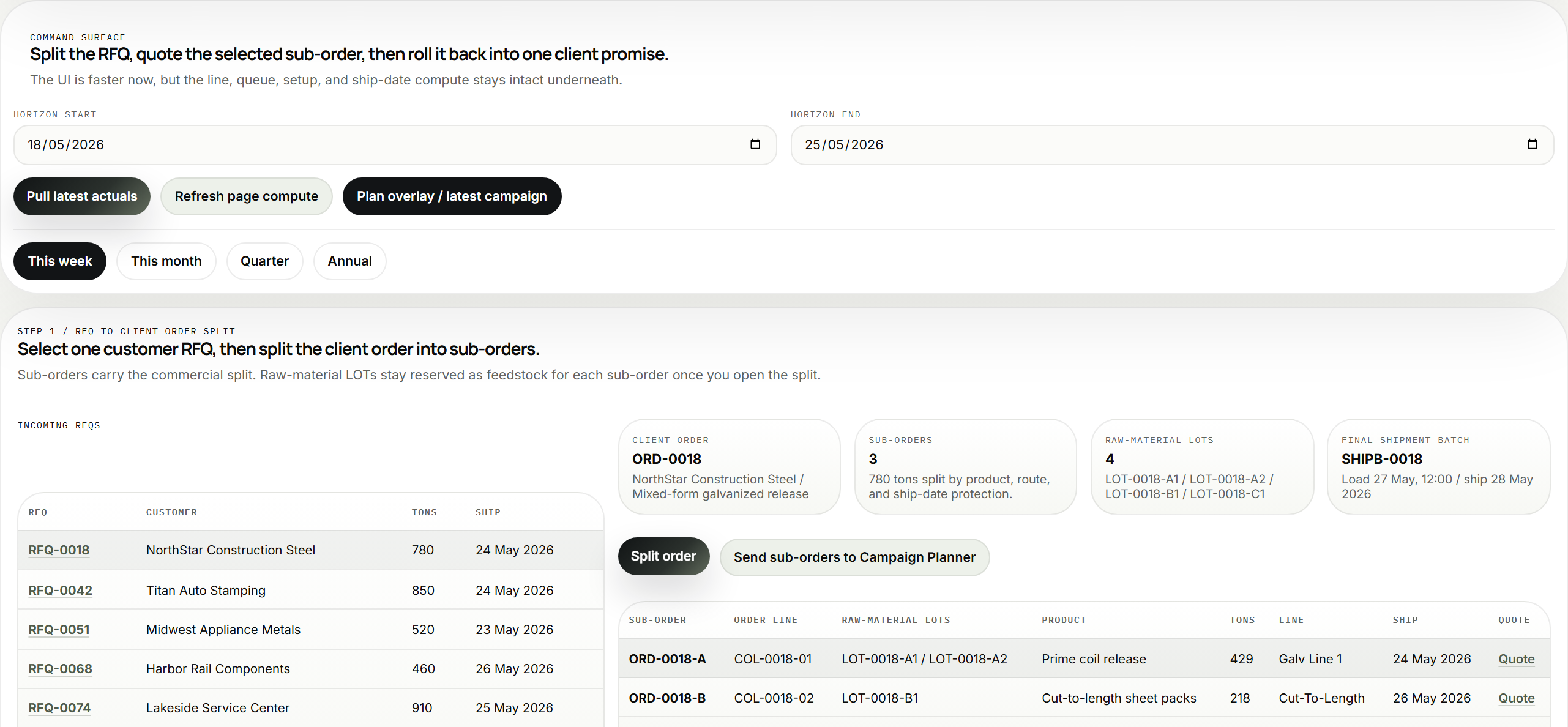
Quote desk
Split the RFQ before the promise goes out.
The quote desk keeps client order, sub-order, lot, line, and ship-date context in one operating surface.
Before a quote becomes a promise, MillFlow shows the real margin, line fit, ship-date risk, and energy cost behind it.
Real margin x line fit x ship-date risk x energy cost
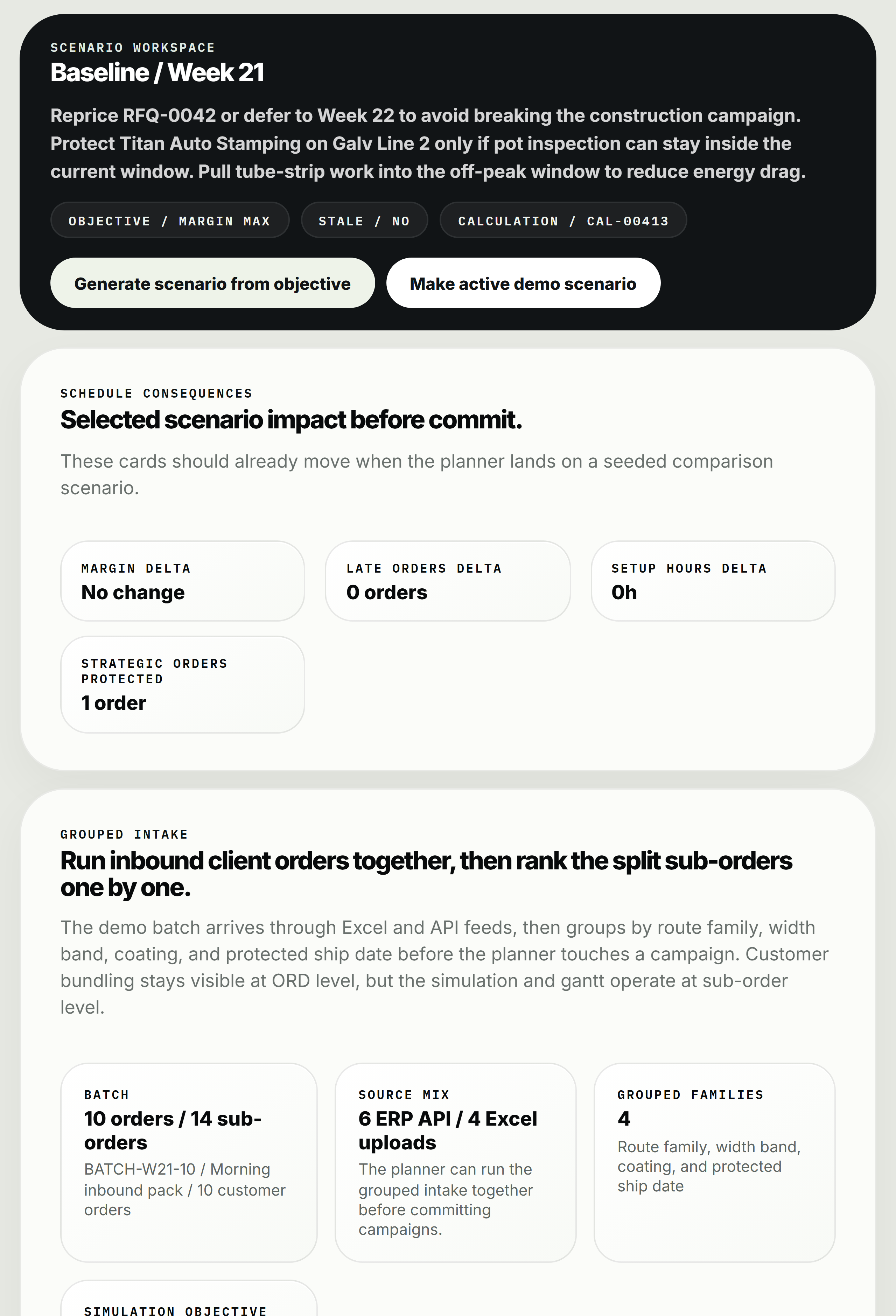
Steel mills already have ERP, planning tools, spreadsheets, and experienced operators. The problem is not missing data. The problem is that order acceptance still gets assembled across disconnected systems and judgment calls. By the time line reality, ship-date risk, and energy cost are visible, the commercial promise has often already been made.
The current stack can store the data, but it does not give the commercial leader one trusted answer on whether the mill should commit right now.
Every quote is a trade-off between revenue, line reality, promise risk, and energy timing. MillFlow scores that trade-off before the commercial answer leaves the desk.
Price, order value, customer priority, delivery penalties, and product mix.
Route fit, bottlenecks, setup families, queue reality, maintenance state, and yield.
Time-of-use electricity, process load, energy intensity, and cost exposure by route.
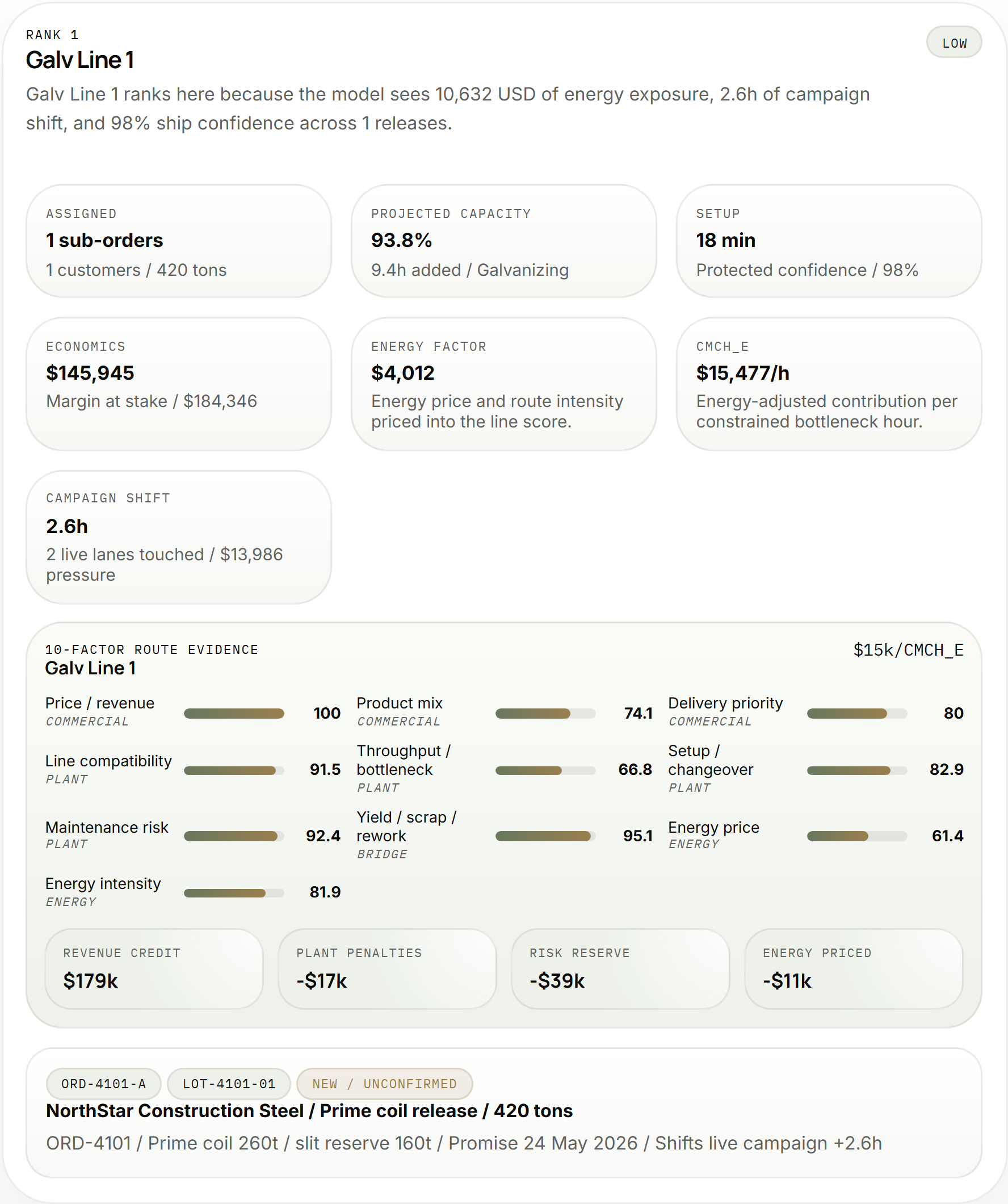
MillFlow begins where commercial leaders lose control: what to quote, what to accept, when to run it, and what margin remains after setup, yield, delay, disruption risk, and energy are priced in.
MillFlow captures live plant realities from ERP, MES, historians, maintenance, and energy systems into a computable plant context.
The model prices the trade-off between commercial value, plant feasibility, and energy cost against the real queue and route options.
The team gets a defensible answer on whether to take the order, how to group it, what to charge, and what to promise.
The same margin calculation follows the team from quote intake, to plant reality, to energy timing.
The quote desk keeps client order, sub-order, lot, line, and ship-date context in one operating surface.
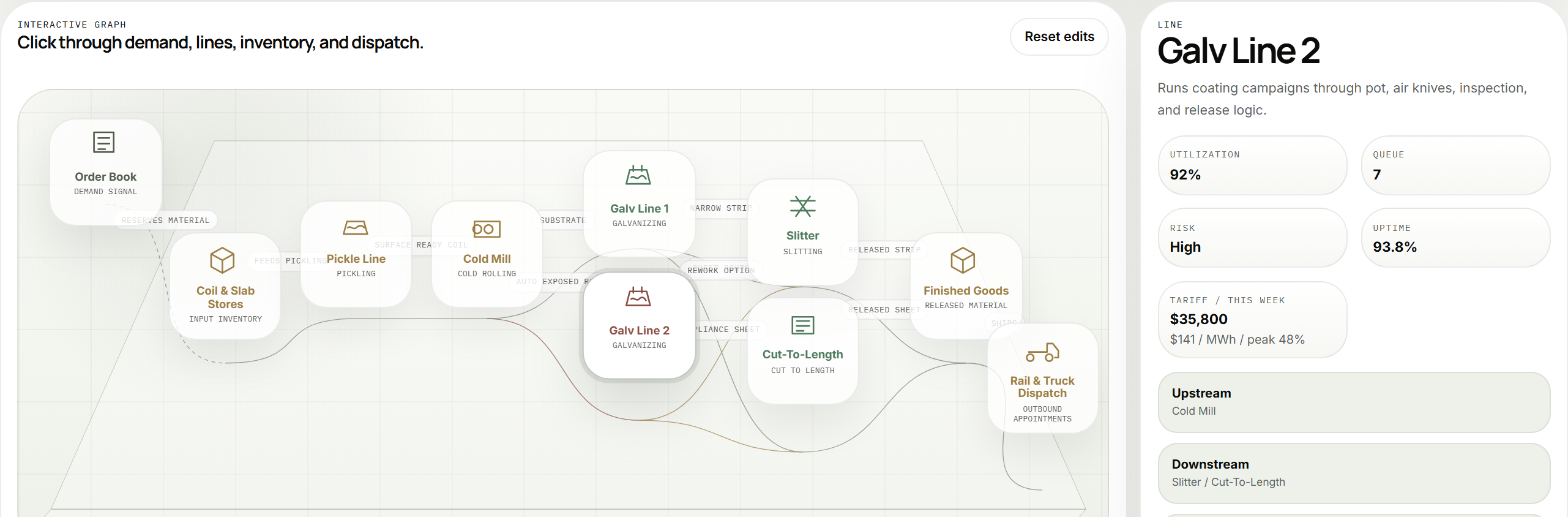
Line capability, upstream and downstream dependencies, child assets, queues, risk, and uptime stay attached to the decision.
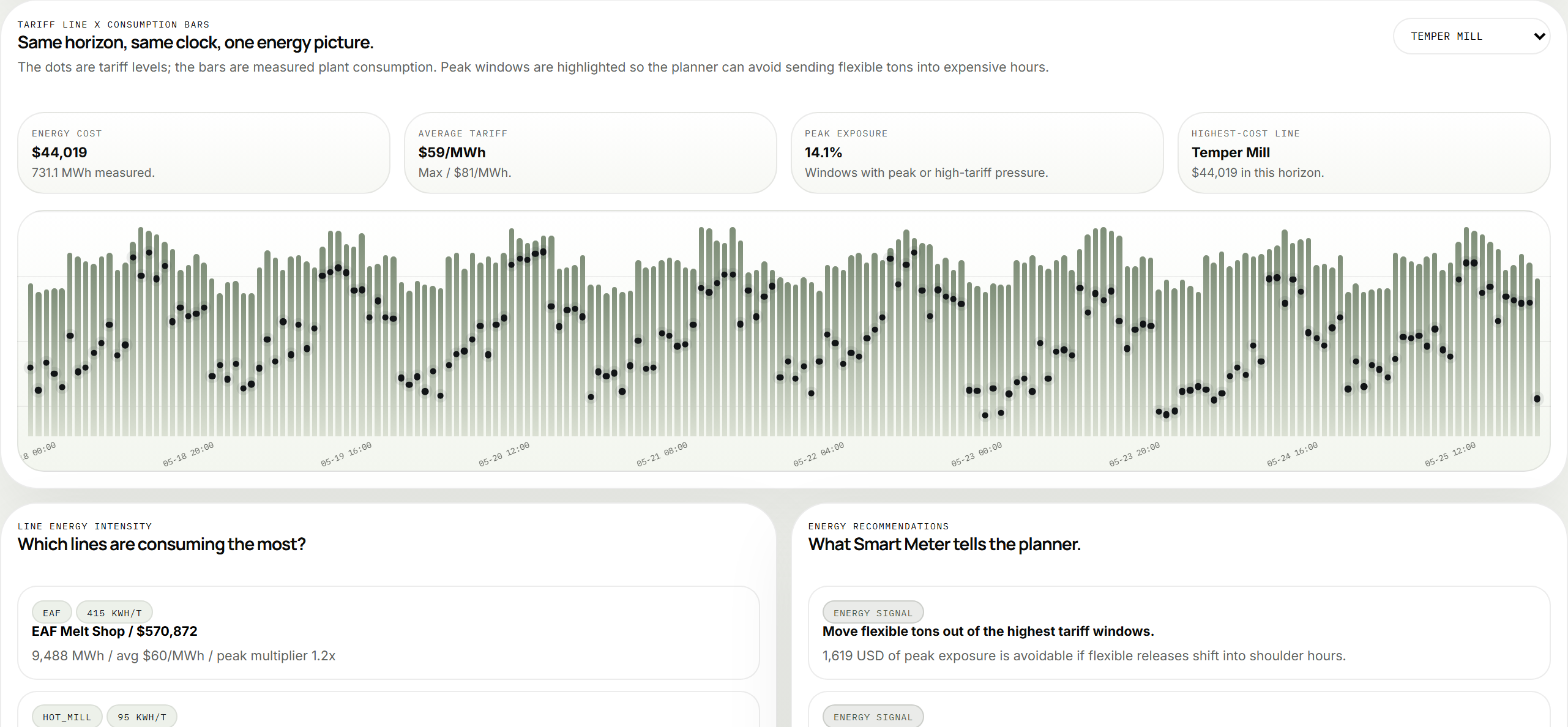
Tariff dots and measured consumption bars give the planner the same horizon, clock, and cost exposure.
The commercial wedge is tight: Quote Desk, Campaign Planner, and Executive View keep every commitment tied to the same plant-aware margin calculation.

Decide whether to take the order, how to split or group it, what to charge, and what lead time is credible before the quote becomes a promise.

Compare contribution, setup loss, line fit, and energy spend before the schedule absorbs the cost.

Roll up new commitments against current constraints so CEOs and CFOs can see margin and delivery risk before it compounds.
If commercial commitments are moving faster than plant truth in your mill, let's talk. MillFlow starts where order acceptance meets line constraints, energy cost, and real operating margin.
Use existing ERP and MES exports, then produce decision recommendations within weeks.